RATIO
Twice the teeth, half the speed
Britannica's example: if the driven gear has twice as many teeth as the small one driving it, it turns at half the speed with twice the torque.
See the oldest gears doodlegears
HOW THINGS WORK
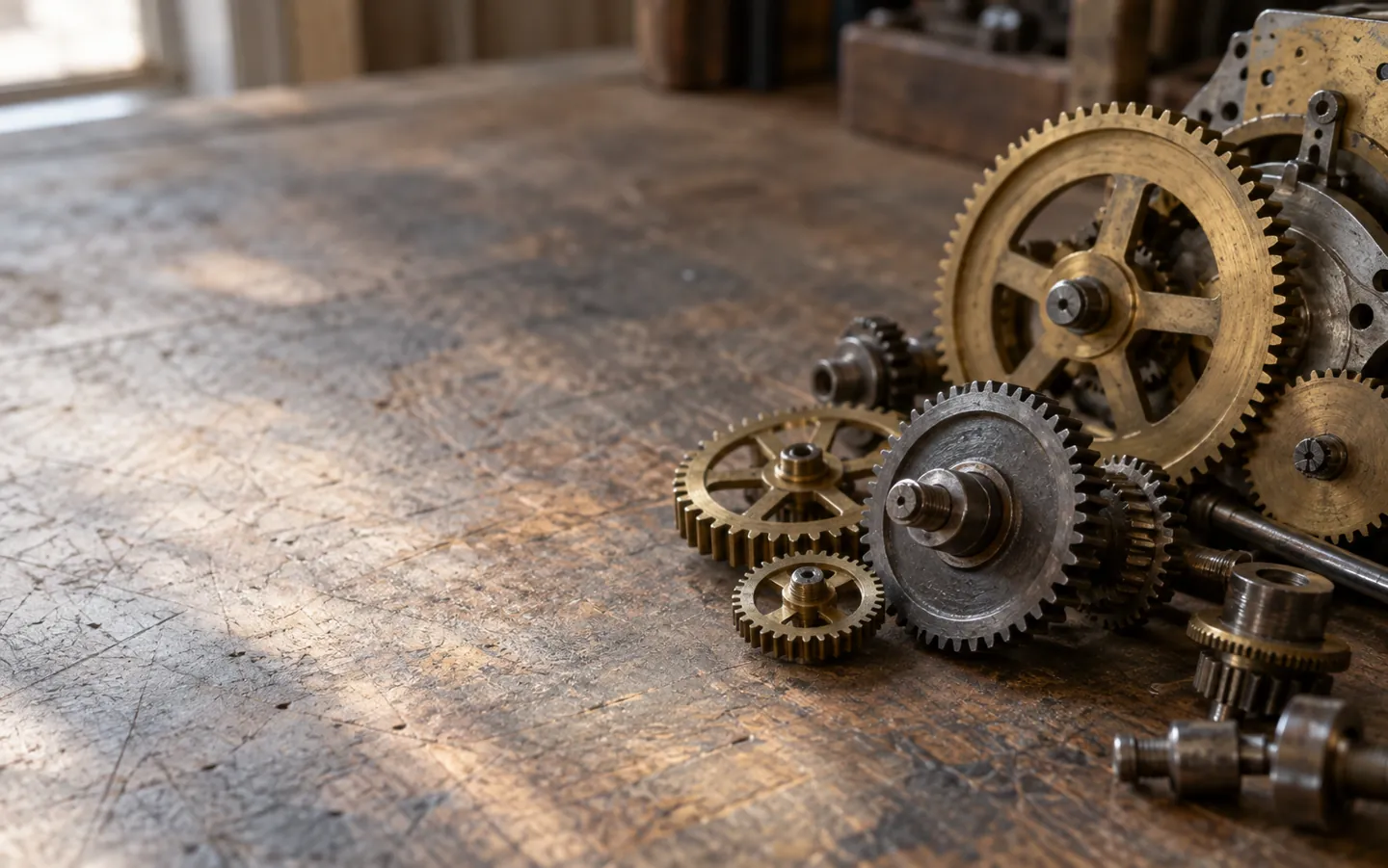
Gears trade speed for turning force.
A gear is a toothed wheel on a shaft that meshes with another without slipping. Count the teeth on each and you know how much faster one turns, and how much harder the other can push.
COUNT THE TEETH that is the whole ratio
Try a bike gearTHE SHORT ANSWER
Two meshing gears do the same work.
What one gains in speed, the other gains in force.
RATIO
Britannica's example: if the driven gear has twice as many teeth as the small one driving it, it turns at half the speed with twice the torque.
See the oldest gearsTORQUE
Torque is turning force. Because work in equals work out, a slower output gear can push harder, and a faster one pushes less hard.
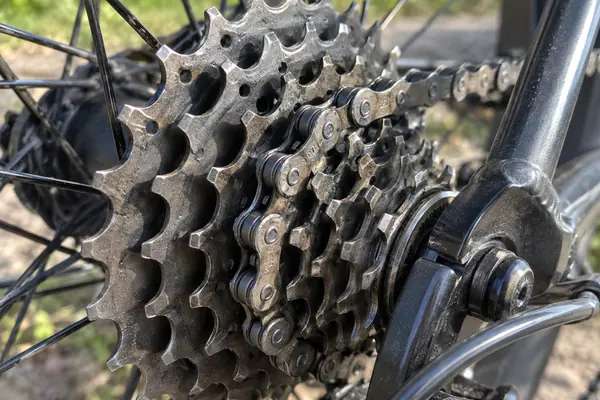
Try a bike gearBICYCLES
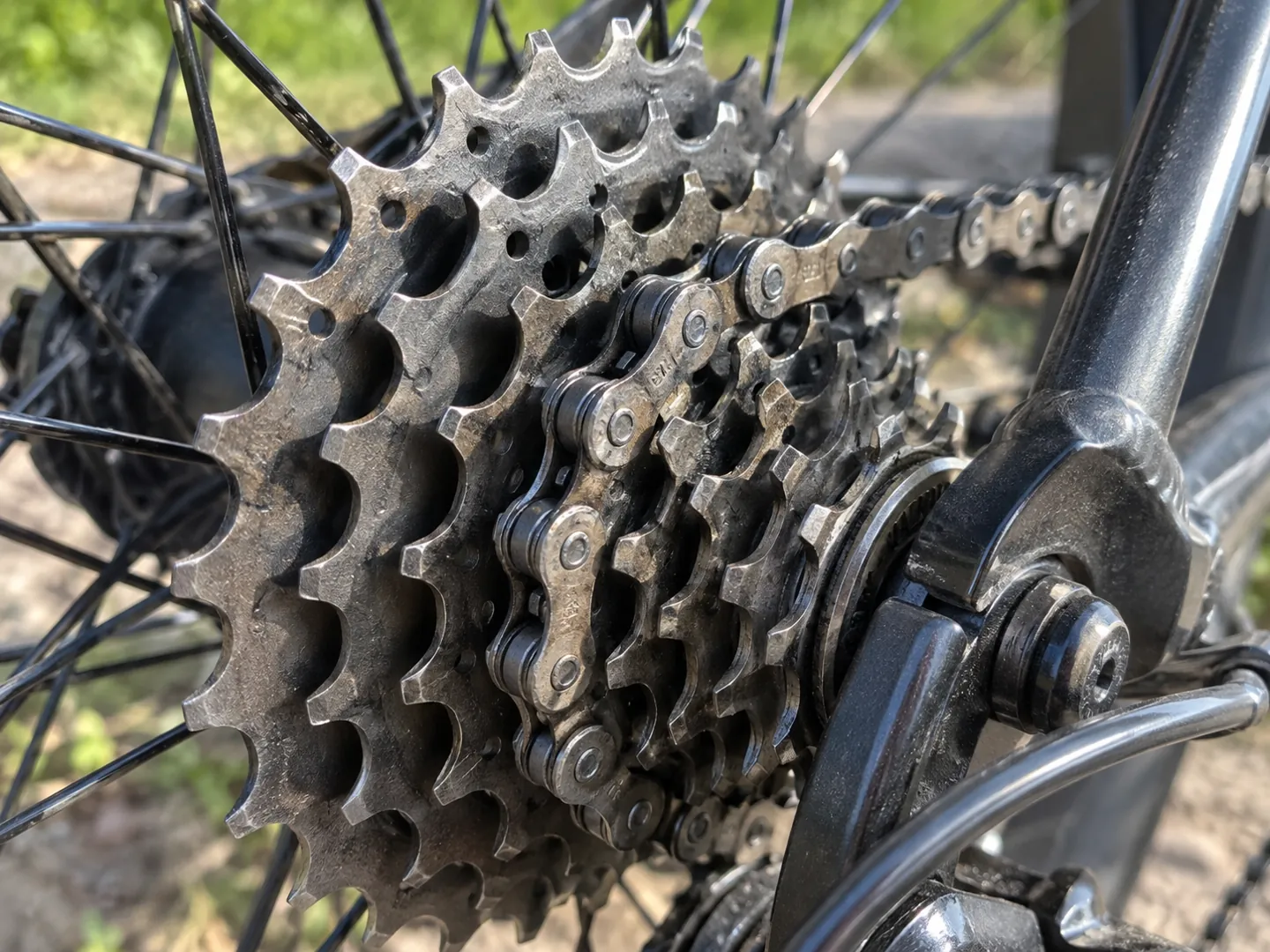
A small front chainring with a large rear sprocket gives a bigger mechanical advantage for climbing. The reverse suits speed on the flat or downhill.
Check your own bike
FOUR STEPS ON YOUR OWN BIKE
You need nothing but your eyes and a little patience: count the teeth on the front chainring and the rear sprocket you are using.
Note the front chainring and rear sprocket tooth counts, such as 34 and 34.
Equal counts make a 1:1 ratio. A rear sprocket with twice the chainring's teeth turns your effort into twice the torque at the wheel.
Move to the smaller chainring and a bigger rear sprocket for climbing, and the reverse for speed on the flat.
Cycling UK's test: your bottom gear should feel too low at the start of a ride, even on the steepest hill you are likely to meet.
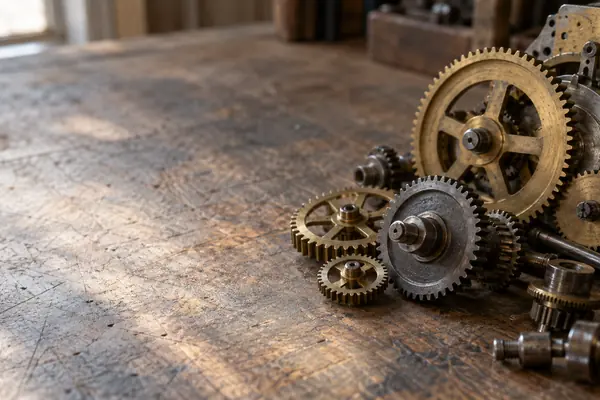
THE OLDEST KNOWN GEARS
The Antikythera mechanism was found in a shipwreck in 1901
and built around the end of the second century BC.
30 gears
Bronze gears that survive
UCL researchers say only about a third of the mechanism survives, in 82 fragments, including 30 bronze gears. It predicted eclipses, lunar phases, planetary positions and even Olympic dates.
SURVIVING PARTS · UCL
1,000+ years
Ahead of any known device
A 2006 study in Nature found it technically more complex than any known device for at least a millennium afterwards.
COMPLEXITY · NATURE
Greek sponge divers found the mechanism in a Roman-era shipwreck off the island of Antikythera. In 2021 a UCL team published a reconstruction of the gearing behind its front display of the cosmos.
A QUICK BIKE GEAR CHECK
Cyclists measure gears in inches. Pick a combination of front and rear teeth from Cycling UK's examples to see its size. The bar shows how big, and how hard to push, the gear is.
Figures from Cycling UK. Lower numbers are easier to pedal uphill; higher numbers cover more ground per pedal turn but need more effort.
KINDS OF GEAR
Spur gears have straight teeth parallel to the shaft and link parallel shafts. Helical gears do the same job with twisted, screwlike teeth. Bevel gears have teeth on cone-shaped surfaces to link shafts that meet at an angle.
A worm looks like a screw and drives a gear on a shaft usually at a right angle to it. Britannica notes that a worm and gear can achieve a large speed ratio in a single pair.
Questions
It compares two meshing gears. It can be worked out from the number of teeth on each, their radii or how fast each turns. The gear with more teeth turns more slowly.
The work going in equals the work coming out. If the output gear turns through a smaller angle, it must push with more torque. Britannica's example: twice the teeth means twice the torque at half the speed.
A small front chainring with a large rear sprocket gives a larger mechanical advantage, so you can pedal uphill with less effort. Big front and small rear suits speed on the flat or downhill.
A geared bronze device built around the end of the second century BC that calculated and displayed astronomical cycles, including lunar phases and eclipses. It was found in 1901 in a Roman-era shipwreck.
UCL researchers say about a third of the mechanism survives, in 82 fragments, including 30 bronze gears. The rest of the gearing has been reconstructed from the fragments and their inscriptions.
Updated
ABOUT THIS NAME
doodlegears.com is part of the DoodleSale portfolio. It isn't in an auction right now, but you can ask about leasing it.